
Here’s something most new dog owners don’t find out until their first vet visit: dental disease is the most common health problem in dogs — and By age three, many dogs show early signs of dental disease.
The good news? It’s almost entirely preventable. And you don’t need a lot of time, expensive tools, or a dog that loves having their mouth touched right away. You just need to know where to start.
This guide walks you through everything — why it matters, how to actually do it, what to use, and how to make the whole process easier for both of you. 🐾
Affiliate Disclosure: Some links on this page are Amazon affiliate links. As an Amazon Associate, we earn from qualifying purchases. This comes at no extra cost to you. We only recommend products we would use for our own dogs.
🤔 Why Does Dog Dental Care Actually Matter?
It’s easy to think of dental care as optional — something nice to do but not really essential. Most dog owners skip it entirely. But here’s what’s actually happening inside your dog’s mouth when teeth go uncleaned:
- 🦠 Bacteria from food builds up on the teeth within 24–48 hours, forming plaque.
- ⚠️ Plaque hardens into tartar (also called calculus) within days — and tartar can’t be brushed off at home.
- 😬 Tartar buildup leads to gingivitis (inflamed, painful gums), then periodontal disease — infection deep in the gum line.
- 💔 In advanced cases, the bacteria from infected gums can enter the bloodstream and affect the heart, kidneys, and liver.
And here’s the kicker: dogs are very good at hiding tooth pain. They’ll keep eating, keep playing, keep acting normal — while quietly dealing with serious discomfort. By the time most owners notice something is wrong, the problem is already advanced.
Regular brushing is the single best thing you can do at home to prevent all of this. 🙂
If you’re building an at-home care routine beyond dental hygiene, our Essential Grooming Basics Every Dog Owner Should Know… guide walks you through the core habits that keep dogs healthy and comfortable
🚨 Signs Your Dog May Already Have Dental Problems
Before you start a dental routine, do a quick check. Watch for:
- ❌ Bad breath — a little doggy smell is normal, but truly foul breath is a red flag
- ❌ Yellow or brown buildup on the teeth (especially near the gum line)
- ❌ Red, swollen, or bleeding gums
- ❌ Dropping food while eating, or chewing only on one side
- ❌ Pawing at the mouth or rubbing their face on furniture
- ❌ Loose or missing teeth
- ❌ If you notice heavy tartar, swollen/bleeding gums, broken teeth, or strong mouth odor that doesn’t improve, book a vet visit—home care helps, but it can’t fix infections or painful dental disease.
If you notice any of these — especially heavy tartar buildup or red gums — book a vet appointment before starting brushing at home. Your vet may recommend a professional cleaning under anesthesia first, and then you can maintain from there.
💡 Tip: Most vets do a free or low-cost dental check during annual wellness visits. Ask them to take a look at the teeth every time you go.
🛒 What You Need to Clean Your Dog’s Teeth
✅ Dog Toothpaste (Never Human Toothpaste)
This one is non-negotiable. Human toothpaste contains xylitol and fluoride — both of which are toxic to dogs. Always use toothpaste made specifically for dogs.
The good news: dog toothpastes come in flavors like chicken, peanut butter, beef, and vanilla — which means most dogs actually enjoy the taste. This makes the whole process much easier.
✅ A Dog Toothbrush (or a Finger Brush)
You have a few options:
- 🪥 Dog toothbrush: Looks like a smaller human toothbrush with softer bristles. Works well for dogs who are already comfortable with brushing.
- 🫶 Finger brush: A silicone cap that fits over your fingertip. Great for beginners and puppies — it gives you more control and feels less intimidating for your dog.
- 🦷 Dual-headed toothbrush: Has two heads at different angles to reach back teeth more easily. Good once your dog is comfortable with the process.
Start with a finger brush if your dog has never been brushed before. It’s the gentlest introduction. 🙂
✅ Dental Chews (As a Supplement, Not a Replacement)
Dental chews can help reduce plaque between brushing sessions — but they don’t replace brushing. Think of them the way you’d think of mouthwash: helpful, but not enough on its own.
Dental chews add calories, so if you’re using them daily, check our How Much Should I Feed My Dog? A Complete Guide for Puppies, Adults & Seniors to keep portions balanced.
Look for chews with the VOHC seal (Veterinary Oral Health Council) — that means they’ve been independently tested and shown to actually reduce plaque or tartar. More on our picks below. 👇
🗓️ How to Brush Your Dog’s Teeth: A Step-by-Step Plan
The biggest mistake people make is going straight for the full brush on day one. Most dogs react badly to that — and then never want their mouth touched again. The key is going slow and building positive associations first.
Step 1: 🖐️ Get Your Dog Comfortable With Mouth Touching (Days 1–3)
Before any toothbrush comes out, just work on making your dog comfortable with you near their mouth.
- Let your dog sniff your hand, then gently lift their lip for 1–2 seconds.
- Release and immediately give a treat. ✅
- Repeat this a few times per session, keeping it calm and positive.
- Gradually work up to touching their teeth and gums with your finger for a few seconds.
The goal here isn’t cleaning — it’s just teaching your dog that mouth touching = good things happen.
💡 Tip: Do this after a walk or play session when your dog is relaxed, never when they’re hyped up or anxious.
Step 2: 🦷 Introduce the Toothpaste (Days 4–5)
- Put a small amount of dog toothpaste on your fingertip.
- Let your dog lick it off. No rinsing needed — dog toothpaste is made to be swallowed, so just let them lick and leave a thin coating on the teeth. Most dogs love the taste — this is usually the easy part. 😄
- Next, put a little on your finger and gently rub it along the gum line for a few seconds.
- Treat and praise. ✅
You’re still not brushing yet. You’re just getting them used to the taste and the sensation of something on their gums.
Step 3: 🪥 Introduce the Finger Brush (Days 6–7)
- Put the finger brush on and let your dog sniff and lick it.
- Add a small amount of toothpaste.
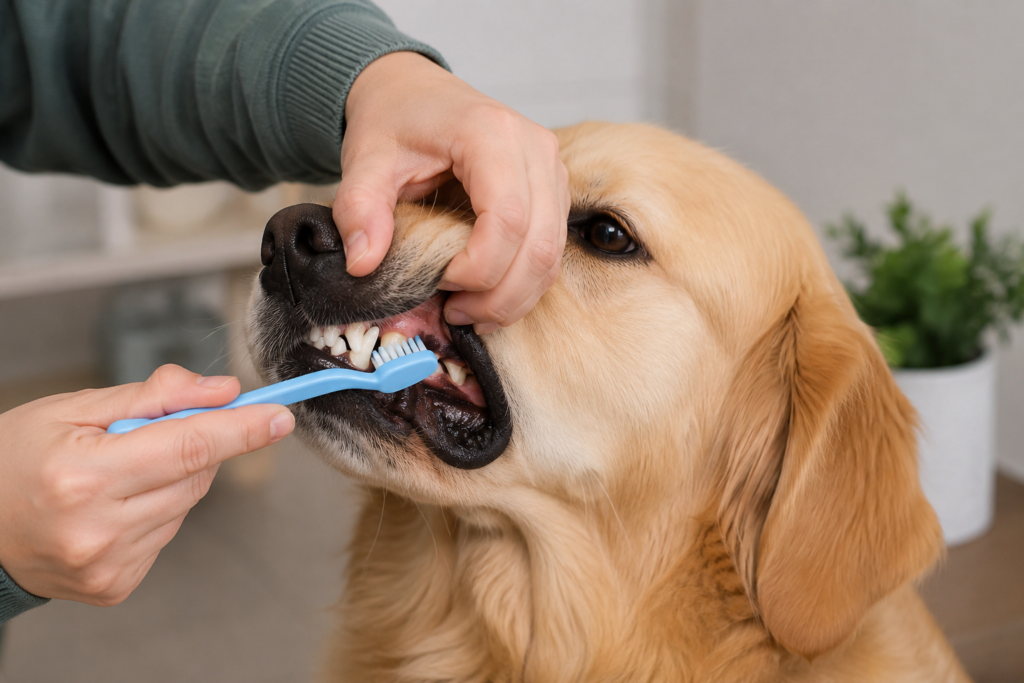
- Gently lift the lip and rub the brush along the outer surfaces of the teeth for 5–10 seconds.
- Stop before your dog gets uncomfortable. End on a calm note. ✅
Focus on the outside of the teeth (the cheek-facing side) — that’s where plaque builds up most, and it’s the easiest area to reach. The tongue naturally helps clean the inside surfaces.
Step 4: 🏆 Work Up to a Full Brush (Week 2 Onward)
- Aim to brush all outer surfaces — front teeth, sides, and back molars.
- Use small circular or back-and-forth motions along the gum line.
- A full brush should take about 2 minutes — 1 minute per side.
- Keep the mood light, treat generously at the end, and make it a consistent routine.
💡 Tip: Same time every day works best. Right before bed or right after dinner are both popular — whatever you can stick to consistently.
⏱️ How Often Should You Brush Your Dog’s Teeth?
Ideally: every day. Plaque begins hardening into tartar within 24–48 hours, so daily brushing gives bacteria the least amount of time to cause damage.
That said — 3–4 times a week is still significantly better than nothing. If daily feels like too much at first, aim for every other day and work your way up. Consistency matters more than perfection here.
⚠️ Common Dog Dental Care Mistakes (and How to Fix Them)
1) ❌ Using Human Toothpaste
Xylitol — a sweetener in most human toothpastes — is toxic to dogs. Even a small amount can cause serious harm.
✅ Fix: Always use toothpaste formulated for dogs. Keep human toothpaste completely out of reach.
2) ❌ Starting Too Fast
Jumping straight to a full brush on day one almost always backfires. A dog that has a bad first experience will resist every session after that.
✅ Fix: Follow the step-by-step plan above. Slow down the intro process — it pays off long-term.
3) ❌ Only Brushing the Front Teeth
It’s tempting to brush the easy-to-reach front teeth and call it done. But the back molars are where tartar builds up fastest and where periodontal disease typically starts.
✅ Fix: Gently pull the cheek back to reach the back teeth. Use a dual-headed brush if needed.
4) ❌ Skipping It When Life Gets Busy
This is the most common one. Dental care is easy to skip because you don’t see the consequences immediately — but they build up fast.
✅ Fix: Attach it to an existing habit (after your own brushing, after evening feeding) so it becomes automatic rather than a decision.
5) ❌ Relying Only on Dental Chews
Dental chews help — but they don’t reach the gum line the way brushing does, and most don’t have enough mechanical action to replace a brush.
✅ Fix: Use dental chews as a supplement to brushing, not a replacement for it.
🦷 Our Dental Care Gear Picks
✅ Recommended Toothpaste: Virbac C.E.T. Enzymatic Dog Toothpaste
Virbac C.E.T. Enzymatic Dog Toothpaste — gentle enzymatic toothpaste to support cleaner teeth and fresher breath (when used with regular brushing).
If you want a dog toothpaste that’s beginner-friendly and widely used, Virbac C.E.T. is a solid pick. It’s made specifically for pets (not humans) and is designed to be used with brushing to help loosen plaque over time.
✅ Why we like it:
- Enzymatic formula helps loosen and break down buildup over time (with brushing)
- Easy-to-use texture that spreads along the gumline
- Non-foaming (dogs don’t “rinse and spit” like we do)
- Good everyday option if you’re brushing a few times a week or more
- Many dogs tolerate it well once they get used to the routine
⚠️ Good to know:
- Start with a tiny amount at first (smaller than a pea) to avoid tummy upset
- Always use dog toothpaste only — never human toothpaste (xylitol can be dangerous to dogs)
- No rinsing needed — dog toothpaste is meant to be swallowed in small amounts
- If your dog has allergies or a sensitive stomach, check the ingredient list and stop if you notice vomiting/diarrhea. Our Organic & Whole Foods for Dogs: What’s Safe and What to Avoid guide can help you spot common triggers and choose gentler options.
- If you see heavy tartar, bleeding gums, or strong mouth odor, check with your vet before starting a home routine
👉Check the current price of Virbac C.E.T. Enzymatic Toothpaste on Amazon here.
✅ Recommended Toothbrush: Virbac C.E.T. Dual Ended Toothbrush (Assorted Color)
If you’re using Virbac C.E.T. toothpaste, this is the easiest “match” toothbrush to pair with it. The dual-ended design helps you reach both front teeth and back molars, where plaque and tartar build up fastest.
Why we like it:
- Dual-ended head makes it easier to reach back teeth
- Soft bristles (gentler on gums than stiff brushes)
- Simple, no-fuss option that works for most dogs
Good to know:
- Color varies (it’s “assorted color”)
- Like any toothbrush, replace it every 2–3 months (or sooner if bristles start to fray)
- Don’t let your dog chew on it—chewing wears the bristles out fast
- Brush gently—if your dog’s gums bleed a lot or seem painful, stop and check with your vet.
👉 Check the current price of the Virbac C.E.T. Dual Ended Toothbrush on Amazon here.
✅ Recommended Dental Chew: Greenies Original Dental Treats (VOHC Accepted)
Greenies Dental Treats are VOHC-accepted for helping reduce plaque and tartar, so they’re a solid add-on to your routine — especially on days brushing doesn’t happen. They’re not a replacement for brushing, but they can help support cleaner teeth and fresher breath between brush sessions.
✅ Why we like them:
- VOHC accepted — independently verified for plaque/tartar control
- Easy daily habit most dogs actually look forward to
- Comes in multiple sizes so you can match your dog’s weight (Teenie, Petite, Regular, Large)
⚠️ Good to know (read before you buy):
- Always supervise chew time and make sure your dog is actually chewing (not gulping).
- If your dog has a sensitive stomach, food allergies, or a history of tummy issues, start slowly (or check with your vet first). If your dog has a sensitive stomach or food allergies, our Organic & Whole Foods for Dogs: What’s Safe and What to Avoid guide can help you spot common triggers and choose gentler options.
- Choose the correct size for your dog’s weight (listed on the bag) — sizing matters for safety and effectiveness.
- Treats add calories — reduce meal portions if needed so you’re not accidentally overfeeding.
- Stop using and contact your vet if your dog has vomiting, diarrhea, or seems unwell after trying a new chew.
- Skip dental chews entirely for dogs who “gulp” treats — those dogs are safer with brushing + other vet-approved options.
👉 Check the current price of Greenies Original Dental Treats on Amazon here.
❓ Dog Dental Care FAQs
How often should I brush my dog’s teeth?
Every day is ideal — plaque starts hardening within 24–48 hours. If daily isn’t realistic right now, aim for 3–4 times a week as a minimum. Even that frequency makes a significant difference compared to never brushing.
My dog absolutely refuses to let me brush their teeth. What do I do?
Go back to Step 1 and slow everything way down. Some dogs need 2–3 weeks just getting comfortable with mouth touching before a brush ever comes out. The goal is to keep every interaction positive and end each session before your dog gets uncomfortable. Patience here pays off enormously. If your dog is truly reactive around their mouth, mention it to your vet — there may be underlying pain making them defensive.
Can I use a regular human toothbrush?
In a pinch, a soft-bristled children’s toothbrush can work — but dog toothbrushes are angled and sized specifically for a dog’s mouth, making them easier to use. The toothpaste, however, must always be dog-specific. Never use human toothpaste.
Do dental chews actually work?
Some do — specifically those with the VOHC seal, like Greenies. But they work mechanically (scraping surface plaque as your dog chews) and can’t reach below the gum line the way brushing can. Use them as part of your routine, not as the whole routine.
How do I know if my dog needs a professional dental cleaning?
If you see heavy yellow or brown tartar buildup (especially along the gum line), red or bleeding gums, or your dog has persistent bad breath that isn’t improving, it’s time for a vet visit. Professional cleanings happen under anesthesia and remove hardened tartar that brushing can’t touch. After a professional cleaning, regular home brushing helps keep things clean much longer.
At what age should I start brushing my puppy’s teeth?
As early as possible — even 8 weeks old. Puppies that get used to mouth handling and gentle brushing early almost always tolerate it much better as adults. Use a soft finger brush and puppy-safe toothpaste to start.
What about water additives and dental sprays?
Some water additives and dental sprays are VOHC-accepted and can help reduce bacteria between brushing sessions. They’re not a replacement for brushing, but they’re a helpful addition — especially for dogs who resist the brush. Ask your vet which ones they recommend.
⭐ Final Thoughts
Dental care is one of those things that feels like extra work — until you realize how much you’re preventing. A few minutes a few times a week can save your dog from serious pain, and potentially save you from expensive vet bills down the road.
Start slow. Use the step-by-step intro. Make it positive every single time. And don’t worry if it takes a couple of weeks before your dog is fully comfortable — that’s completely normal.
Once it becomes part of your routine, most dogs get to the point where they actually look forward to it — especially when the toothpaste tastes like chicken. 🐾
You’ve got this. 🧡
The Dog Care Hub Editorial Team
The Dog Care Hub Editorial Team is a group of passionate dog lovers focused on making everyday dog care simple and beginner-friendly. We combine real-life experience with information from trusted veterinary sources to create clear, gentle guidance for new and experienced dog owners. Every article is reviewed for accuracy, safety, and ease of understanding so you can feel more confident caring for your dog.
🎁 Want the Calm Start Starter Pack (Free PDF)?
Get the free download in one click.
👉 Want to support the site? Shop our Dog Care Hub merch (hoodies, mugs, and more).